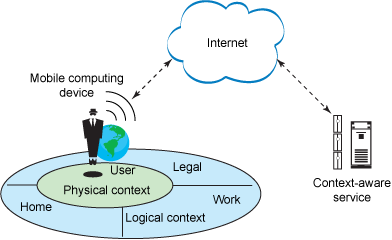
An important aspect of pervasive computing is context-awareness, which has to do with delivering relevant data and services to users based on their current environment. Let's say you're at a mall. If you're not a diver, a message informing you that a store is giving a 60% discount on scuba diving equipment would be of no interest to you. In fact, it might even be annoying to receive messages about things you have no interest in.
On the other hand, if you play tennis and you receive a message that you'll receive 20% discount on a tennis racket if you go to a certain store and show them this message would definitely interest you. Likewise, an alert about a special offer at a nearby ice cream parlor would be welcome on a very hot day.
Context-aware service is about delivering data and services that is relevant to where you are and what you're doing. Often, location plays an important role in determining context.
Dey (2001) defines context as "any information that can be used to characterise the situation of an entity. An entity is a person, place, or object that is considered relevant to the interaction between a user and an application, including the user and applications themselves". Any piece of information that can be used to characterise the situation of a participant in an interaction is context.


